Trigger warning: very unflattering nudity and disturbing images ahead. You have been warned.
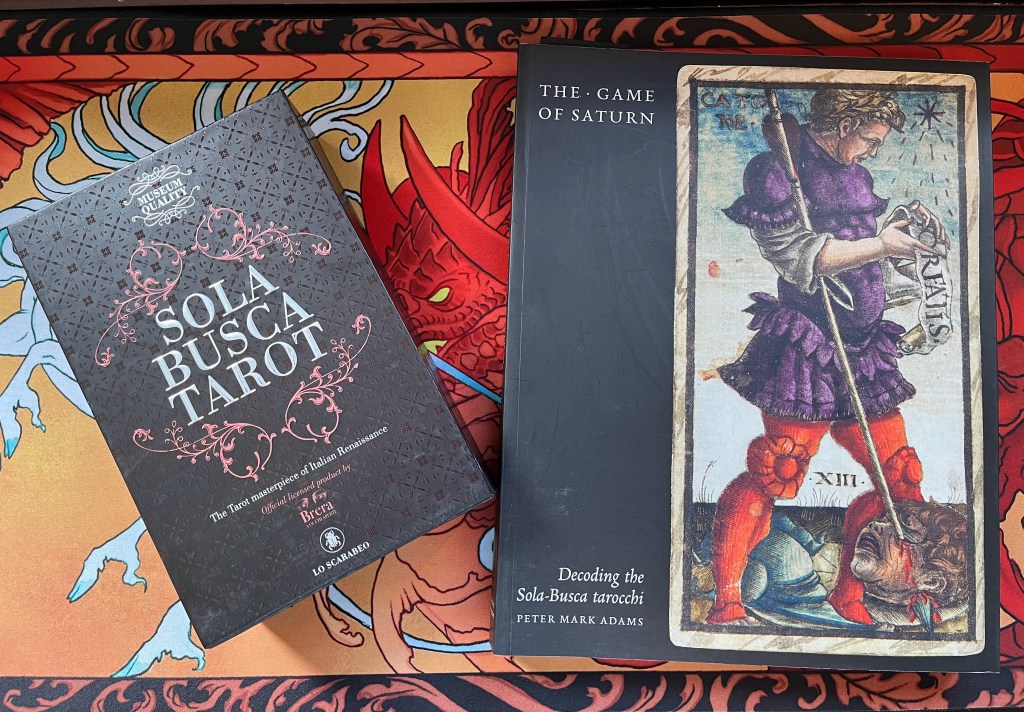
Lo Scarabeo Sola Busca Museum Quality edition (acquired 2021) alongside the book The Game of Saturn
So. I considered not reviewing this deck. I suspect many Tarot enthusiasts have some edition of this deck in their collection and do not talk about it probably for the same reason as I am hesitant to write about it in a public sphere. I am by no means equipped to speak about this deck with any authority as I neither have the education nor research background to attempt to summarize such a historically significant deck that has perplexed countless people and clearly had such a profound affect on legendary Tarot artists, like Pamela Cole Smith. But. I do think that this deck is not talked about enough. What I can share is my personal experiences owning and using and falling down rabbit holes with this deck, and some musings I have in general about the importance of historical artifacts like the Sola Busca. I won’t be “scoring” this deck like normal, other than the production quality, as this deck has more than proven its worth as a social artifact in the Tarot and historical community.
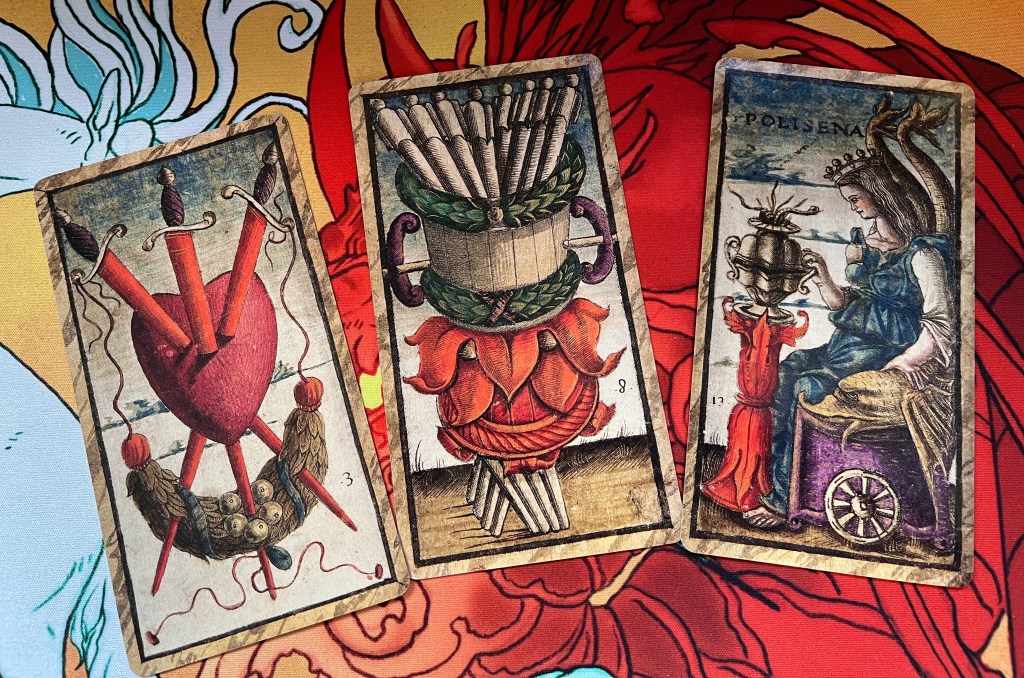
3 of Swords (look familiar?), 8 of Batons, Queen of Cups
Overall: I think this deck is an incredible object because, I personally believe, it sums up the Tarot. It is strange, it is an amalgamation of imagined esoteric images from a past world, and wrapped in (for it’s time) contemporary references while also completely undermining the establishment. And it’s clearly making an attempt to pass knowledge about profound truths into the future. It has a specific niche audience that seems to be of the occult “in group,” though at it’s core it is a card game, but clearly due to the effort of the artist, it is also a representation of how humans understand life in 78 condensed, critical images. It is sacred, it is profane. And, many people try to explain it but no one really knows what is going on. In other words, it’s completely unhinged and baffling and so, so intriguing which is what I believe Tarot, at the end of the day, is.
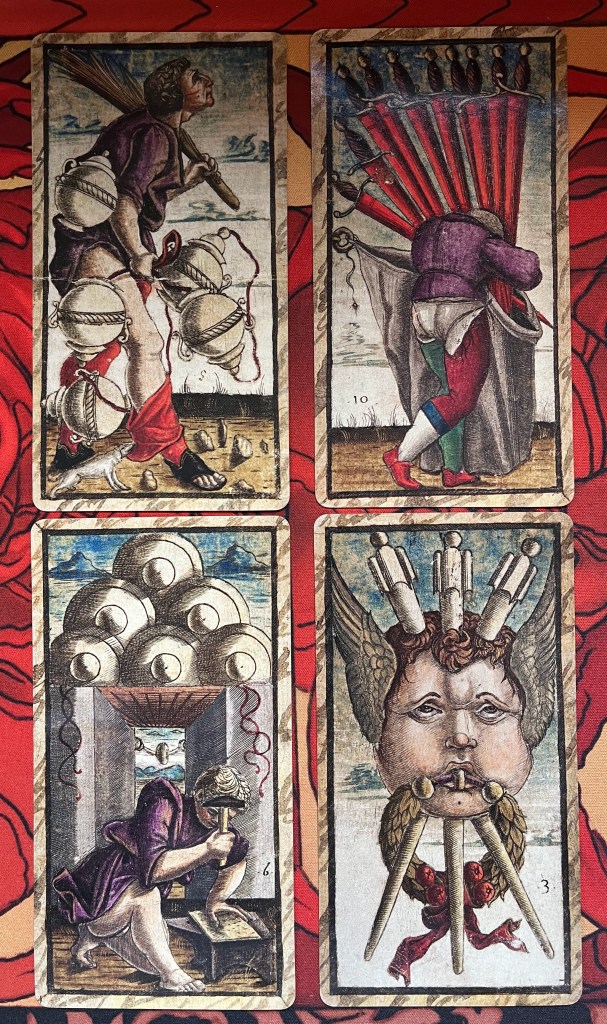
While there isn’t concrete proof that Pamela Cole Smith saw the Sola Busca Tarot on display in a museum, we know pictures of it were at a museum near her at the time the Rider-Waite Tarot deck was created and it is generally agreed upon that the Sola Busca was a muse for Smith. I would also argue that this deck affected decks throughout history, as you can see The Fool here is an image most related to the classic Marseilles Tarot which came almost 200 years after the Sola Busca. The 10 of Swords looks a whole lot like the Rider Waite 10 of Wands, the 6 of Coins (er, shields?) looks a whole lot like the 8 of Pentacles, and the 3 of Batons as well as the 3 of Swords seen above look very much like the RWS 3 of Swords, don’t they?
I don’t have a particular laundry list of Tarot pet peeves like many collectors and Tarot enthusiasts tend to have, but I do have one thing that really gets under my skin. It has nothing to do with decks actually but rather a purposeful misinformation in Tarot literature. There are SEVERAL well known books about Tarot that I have purchased (as they are the books everyone reads), but there is a critical statement that makes me put the book down, scan the back of the book for any reference marker for the Sola Busca, and ultimately has lead me to giving the books away without further reading. And that common lie in the tarot community, typically is along the lines of “The minor arcane ‘pip’ cards were not fully illustrated until (more modern date associated with a particular Tarot artist who illustrated the pips).”
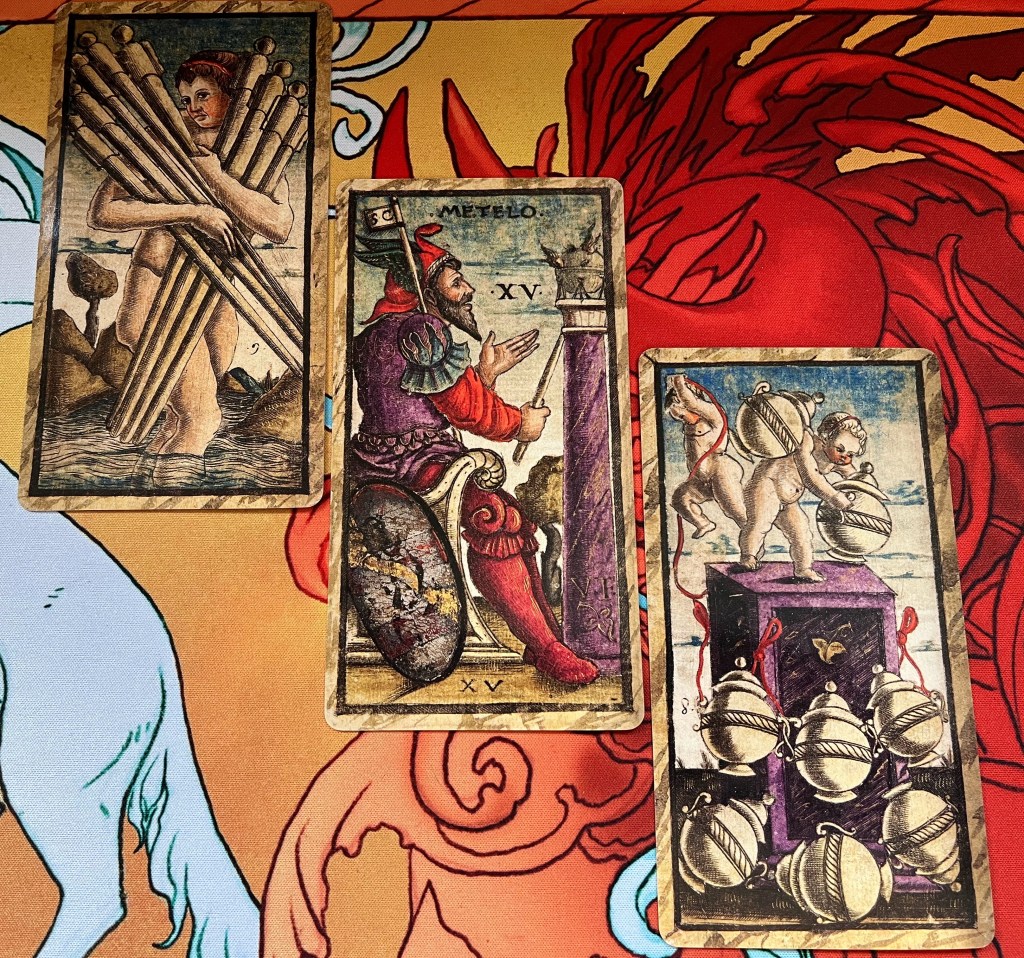
These two “pips” look pretty darn fully illustrated to me. The surviving example of the complete Sola Busca deck was finished around 1491. That’s not actually that long after the Tarot craze hit Italy earlier in the 15th century. But the reality is, after countless historians have researched this deck, it’s card “meanings” and purpose largely elude us even though its clear that this deck is truly steeped in the esoteric, occult references of its day. What really gets me is when these same books which seem to not give attribution to the Sola Busca, also tend to mention later in their text that Pamela Cole Smith likely SAW photos of the Sola Busca on display at a museum which explains the similarities of much of her art (like the fully illustrated pips) with this deck. I find this infuriating.
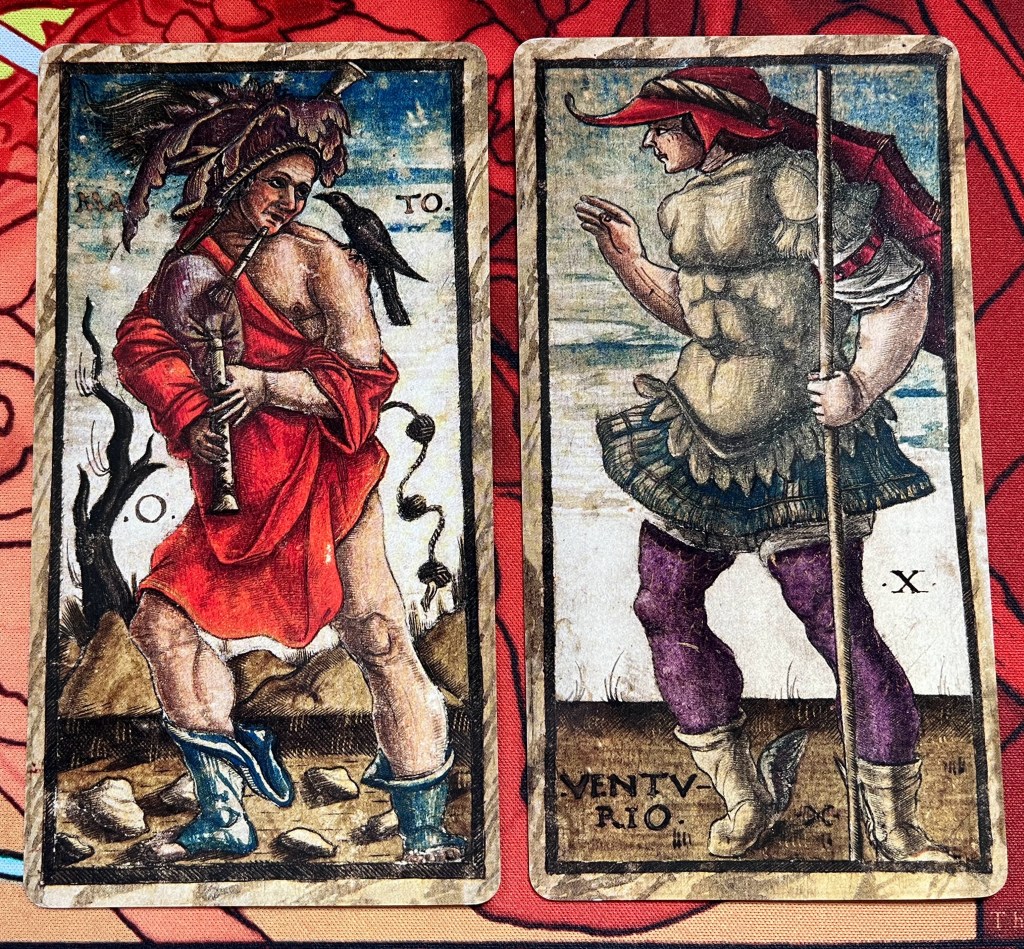
Do these not feel like cards you’d draw out of Ussi’s Pagan Otherworlds Tarot?
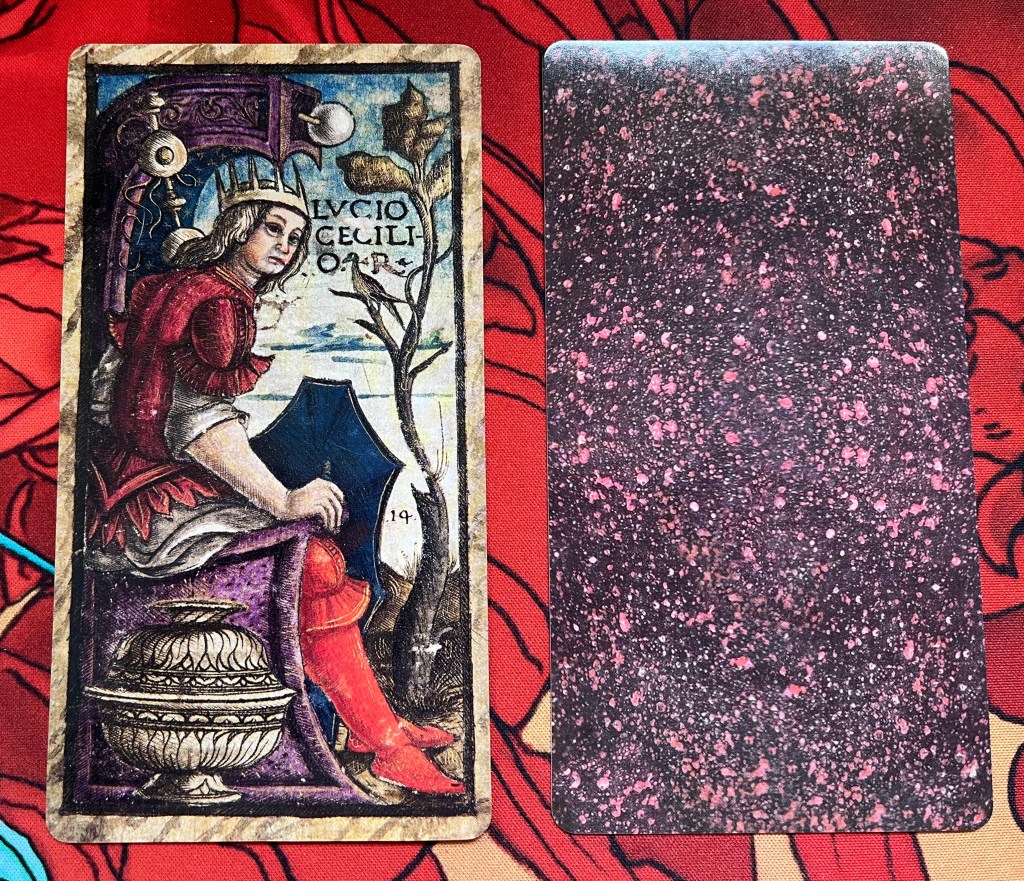
Card Quality: 2.5/5 Perhaps one day I’ll invest in a higher quality version of this deck. They’re okay, glossy, thin, flexible. Prone to chipping. Slightly wider than a standard Tarot and quite a bit taller, these cards feel big in my small hands but not completely unmanageable. The colors on the card are fantastic and do feel “original,” though I’m sure much work has been done to reproduce the images of the museum specimens to an incredibly high standard. The speckled backs feel rather lackluster when given the startling images, but it seems these are the actual backs to the cards, so points for historical correctness.
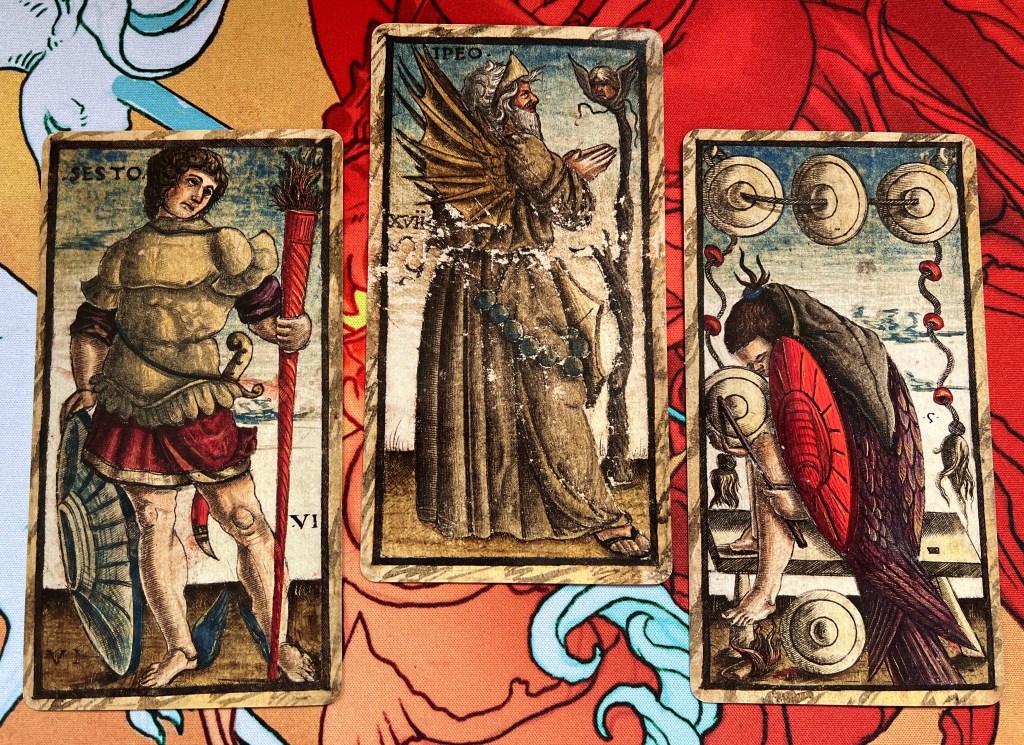
For anyone who has never looked into the Sola Busca before, it is notable in its extremely pagan, alchemic, and heretical imagery in the cards, which at the time were typically illustrated with Renaissance Roman-Catholic imagery.
My understanding is the historic Sola Busca is a complete deck of colored 78 cards; the Sola Busca was a deck made with etched metal plates, and later painted. These cards look exactly like I’d expect cards made this way to look.
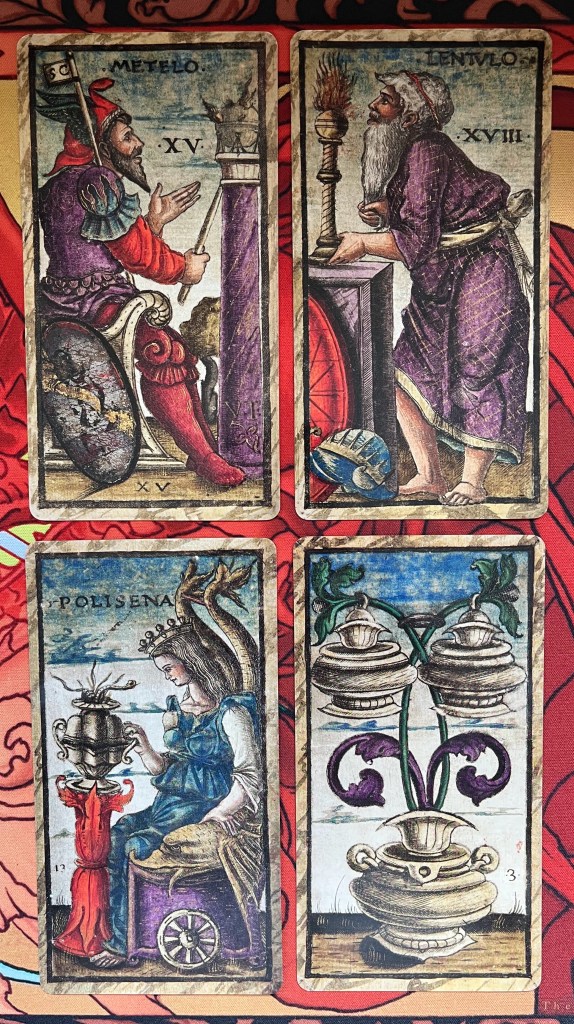
It’s beautiful…
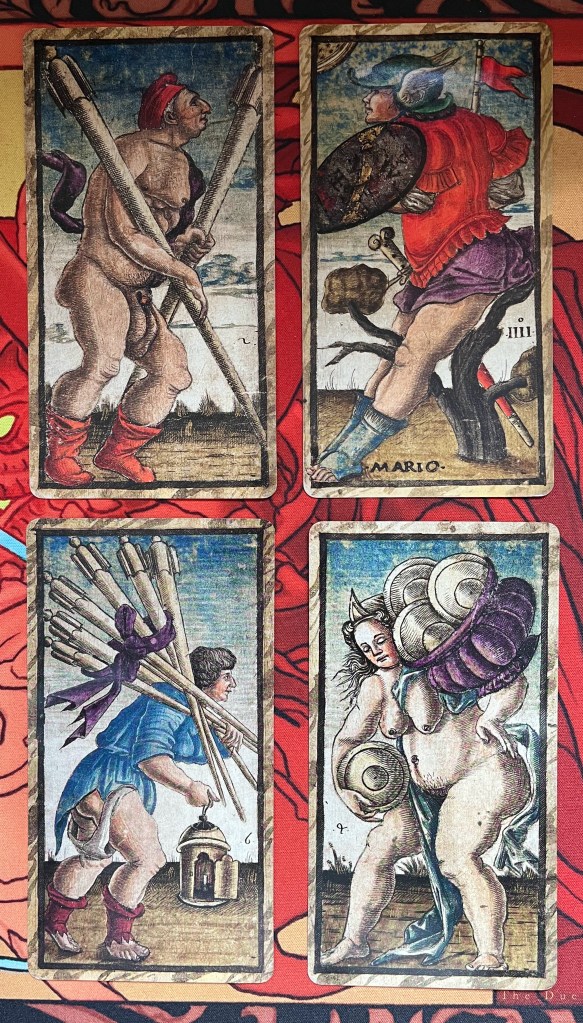
It’s uncomfortably ugly and shocking…
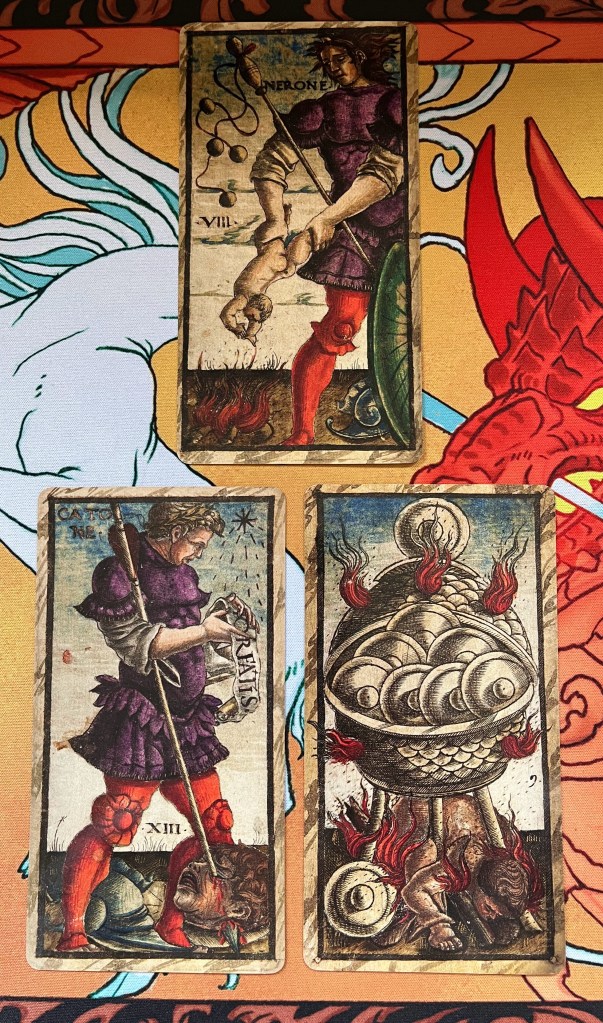
It is gratuitously violent…
Readability: Oh Boy/5. Imagine making a Tarot deck for your friends that is comprised of memes, but these memes that have taken on specific meaning to just you and your friends. But also, you and your friends probably are in a weird cult of memes and you do some really odd and not socially acceptable stuff on Friday nights. Oh and you and your friends are probably fabulously wealthy and have a lot of political clout. Now image someone 535 years later finds your deck and has decided they are going to do a Tarot reading with it. That’s what it’s like trying to read with the Sola Busca.
The book that comes along with the deck is…almost practically useless. Peter Adams in his book The Game of Saturn attempts to tackle the Sola Busca card references. He has some pretty solid historical evidence for many cards, and also make some conjectures, some guesses, and frankly I think he must’ve gone mad in his research (I would’ve) because there some pretty wild conspiracy theories in this dense book. I have slogged through the whole book (which took me several years). It’s one of those things where the more you learn the more you understand how little you know. I certainly cannot say that I “get” this deck, but rather I have come to have an appreciation how Tarot links art, history, literature, politics, culture, and our deep personal understanding of the world, together. Is The Game of Saturn book worth getting? If you are like me and so enamored with the Sola Busca and are willing to read some of the most off-the-charts weird, and dry, history, then yes it is. If you want to be able to “read” with the deck, then you might want to save your money. Or maybe not. Here is a great review of the book: https://www.thequeenssword.com/the-game-of-saturn-decoding-the-sola-busca-tarocchi-review/
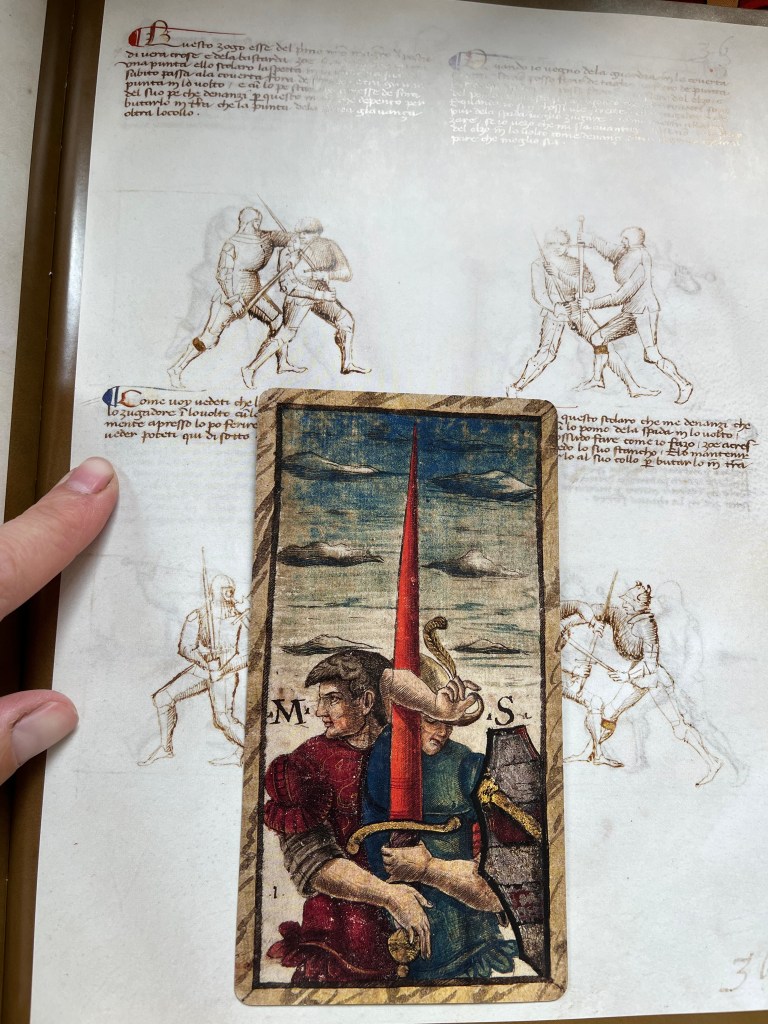
An excerpt of Fiore dei Liberi’s grappling with the sword techniques from his 1409 fight manual Fior di Battaglia, juxtaposed with Sola Buscas 1491 Ace of Swords.
Art: There is almost nothing that can compare with the Sola Busca’s historic art as it clearly inspired many other Tarot decks, and it seems to be the first of its kind. It’s difficult for me to relate to it, as I don’t know the characters inside and out and I am not a part of that culture, but all characters are incredibly human feeling, even more so than many modern decks with “perfect” people. There’s also a density of the images in the cards and its easy to really get lost in the sauce of what is happening, who is named, why is this happening, etc. That being said, I really enjoy looking at this deck compared to other examples of art from that time. Above and below are some images from a copy of a historic fight manual and you can see the consistencies with the Tarot imagery as well!
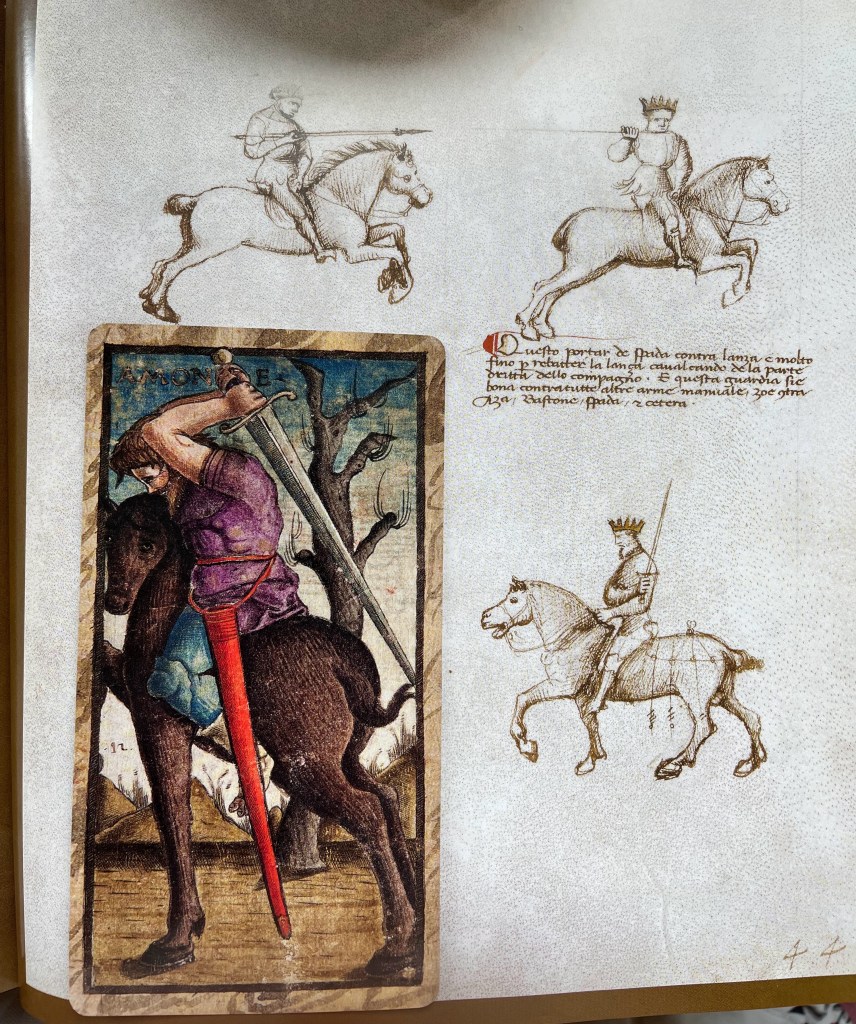
This card (The Knight of Swords) gets me. At face value it looks like the hairy Knight is protecting his exposed quarter (the back, rear left) as one would practically do when fighting from the saddle. But. His strong hand should be under the cross of the sword, but we see he is actually left handed, then we look again and see that it isn’t clear which quarter he is defending, or perhaps he is about to deal a rather ham-fisted blow to something in front of him, but THEN we see he has no reins! Nor a saddle. It’s not a great idea to ride into a fight with no reins, nor to be wielding a weapon two-handed from the saddle, and THEN we notice that the sword scabbard is on the left which means he’s right handed and isn’t holding the sword as we expect and THEN you go look at the other knights and they too don’t have riding tack and you are left wondering why, as knights and their livery would have been well known and understood by the artist so what do they mean about it, and frankly this is how the whole deck behaves.
Favorite Card: It changes, but this King of Cups really makes me feel like the person is gazing out at me and I wonder if its a portrait of the artist.
Boxes it Checks: Renaissance, Historic, Occult, Graphic, Alchemical, Pagan
Similar Decks: Any of the historic Italian decks that are reproduced on the market, Alchemical based decks, decks that have a niche in-group with deep historic lore; the Nemeth Tarot comes to mind, Terra Volatile, Tarot des Ambiguïtés

